- Healthcare AI
- Platform architecture
- Visioning
From admin checklist to point of care assistant
Leading the vision, roadmap, and convergence of an AI-native clinical platform.
- Client
- Counterpart Health
- Delivered
- Product strategy, UX architecture, facilitation, systems
40 PATIENTS A DAY ADDS UP
A clinical assistant used by primary care physicians had grown into four disconnected experiences and feature bloat. It was being used as an end-of-visit administrative checklist, which was neither what it was for nor where its value was.
The product served physicians seeing 40+ patients a day in a value-based care model, where the quality of the encounter drives both outcomes and reimbursement. It had accumulated real capability — a scribe, a patient-data chat, a visit briefing, a task system — and each one worked. The problem was that none of them knew about the others, and the center of gravity had drifted to after the visit: a checklist you cleared once the patient had left.
The AI capabilities arriving over the next year would not fit into that structure at all. The transformation had to be defined end-to-end based on workflows.
QUESTIONS FIRST, PLAN LATER
I facilitated vision workshops with the chief product officer, the design director, and clinical stakeholders. The method was hypothesis-first: each stage of the proposed experience went up with its assumption stated plainly and its unknowns listed, which drove alignment, scope and prioritization. What came out was a shared transformation statement, later written into the project plan.
From
To
Fragmented tabs — Briefing, Tasks, Notes, Chat
A single unified workflow
Tasks as an administrative checklist
The clinical agenda as the plan for the visit
Manual and step-based
Continuous and ambient-driven
AI point solutions
Deeply embedded AI infrastructure
Desktop, workflow-heavy
Mobile-first — portable, ambient, embeddable in the EHR
FORCING THE HARD QUESTIONS
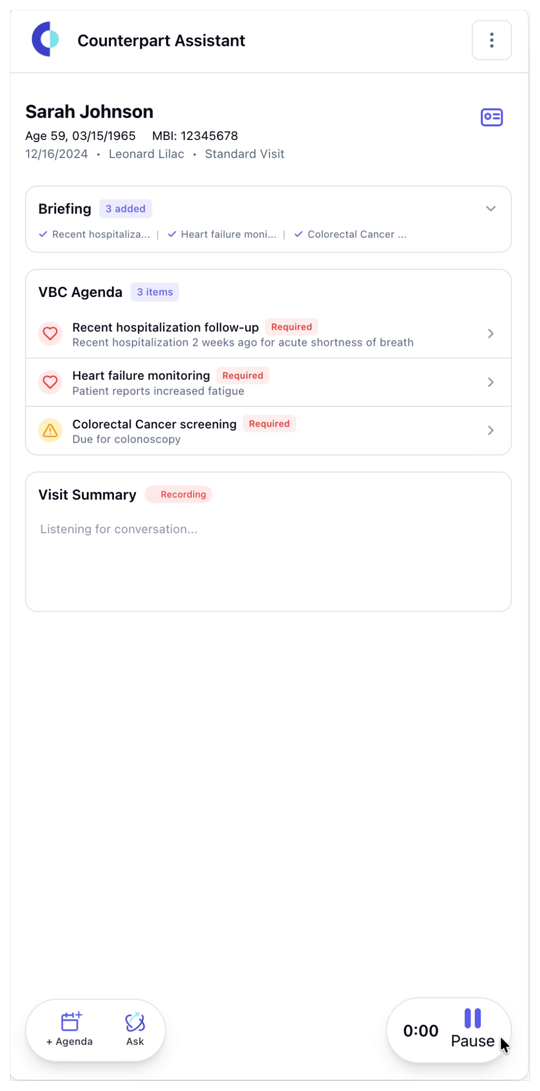
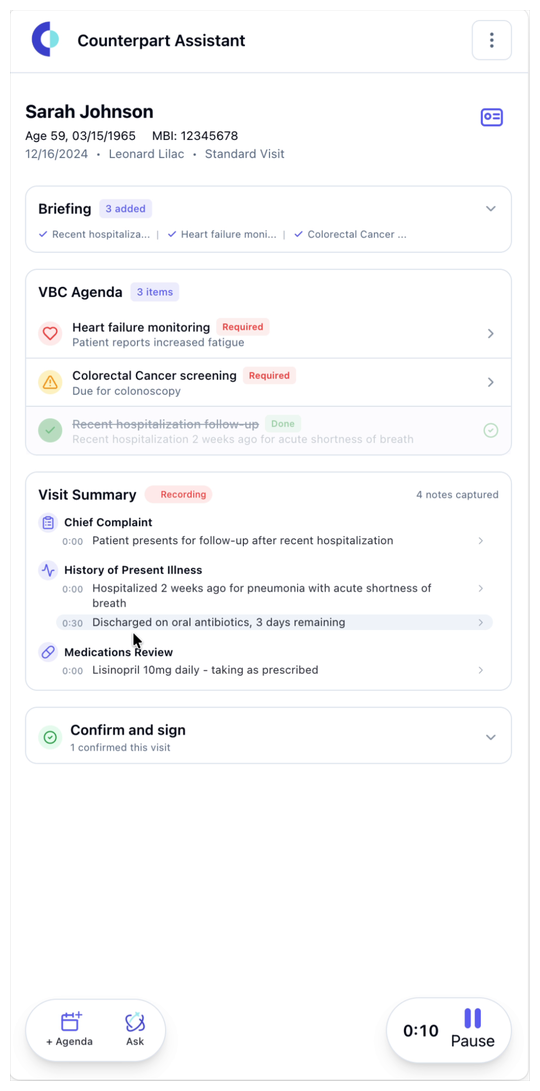
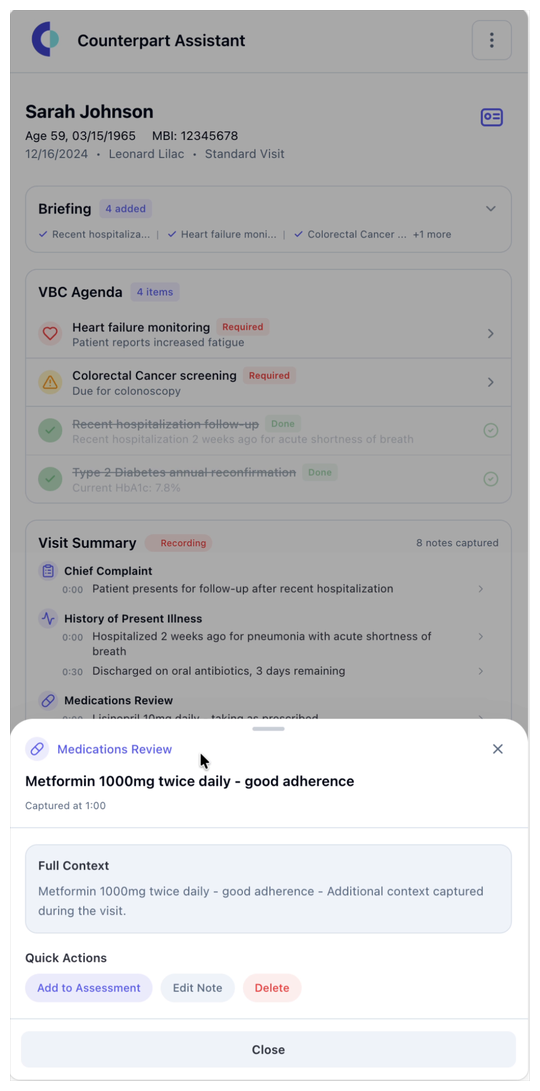
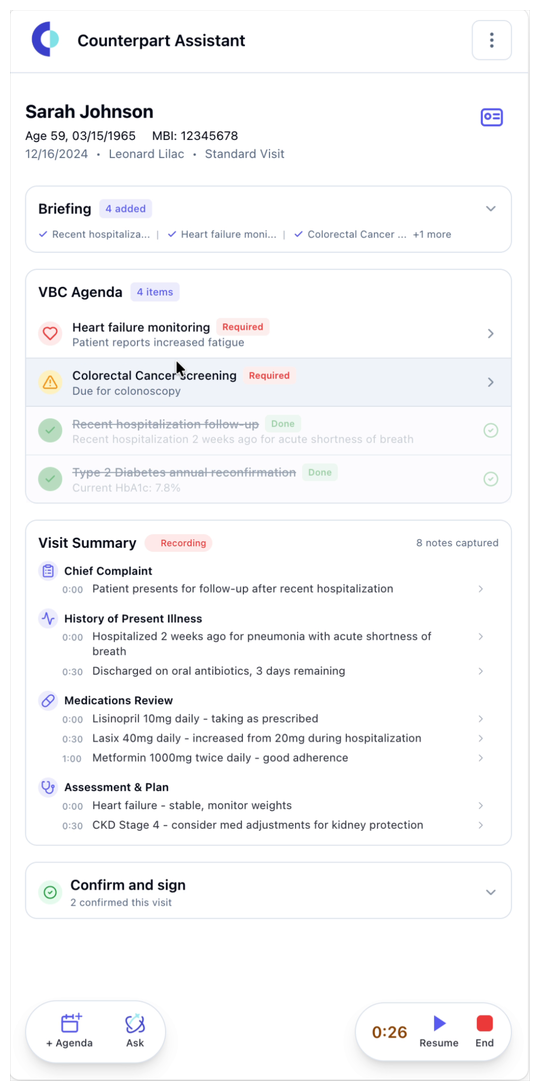
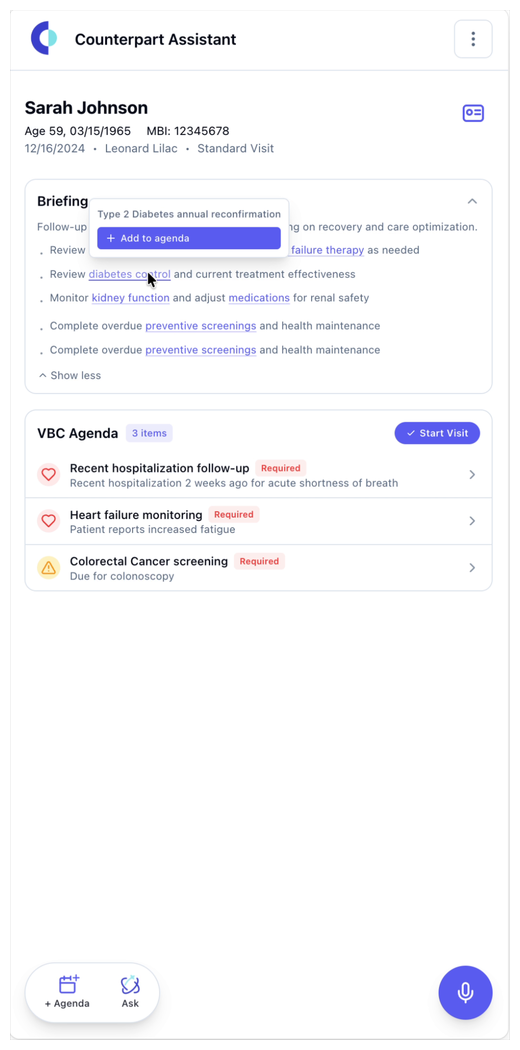
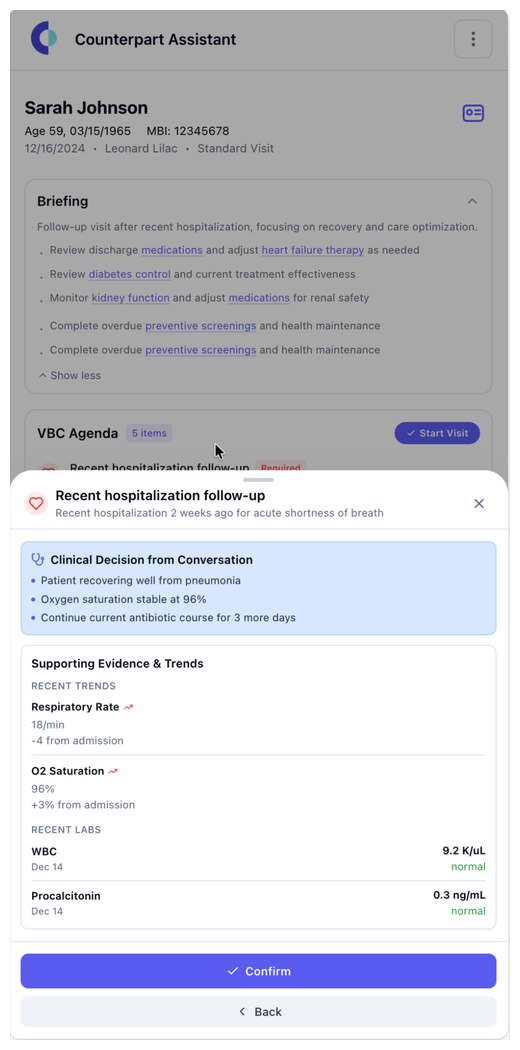
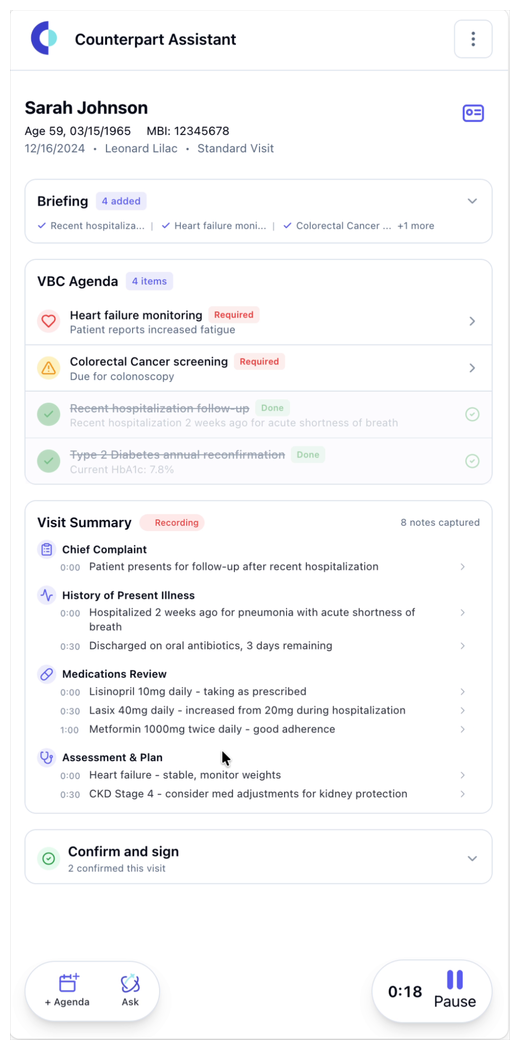
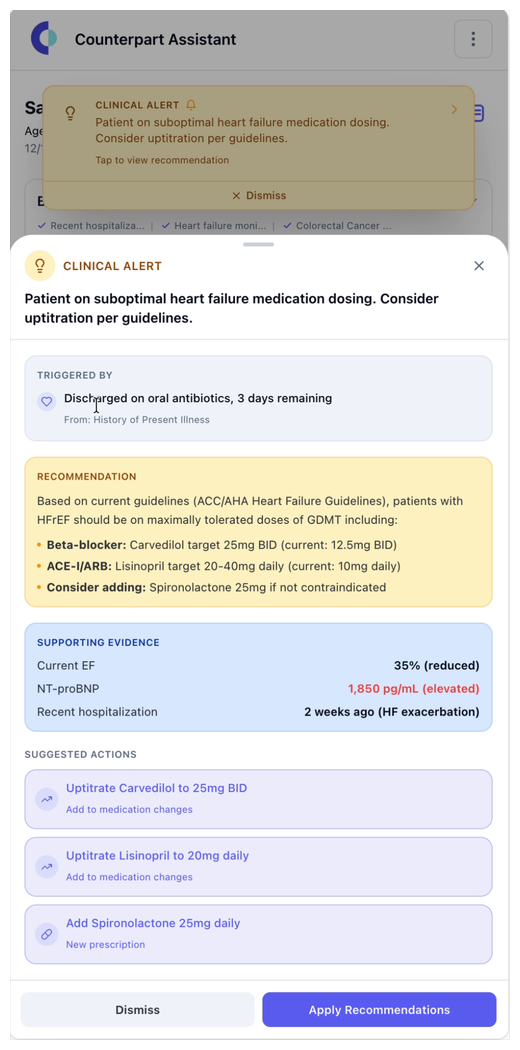
I built the workshop output into an end-to-end vision prototype: the whole visit, pre-visit through post-visit, as one continuous experience. A prototype you can move through forces the hard questions into the open; what happens between steps, what the physician sees when the ambient layer is listening, what the agenda looks like when a patient has nothing going on?
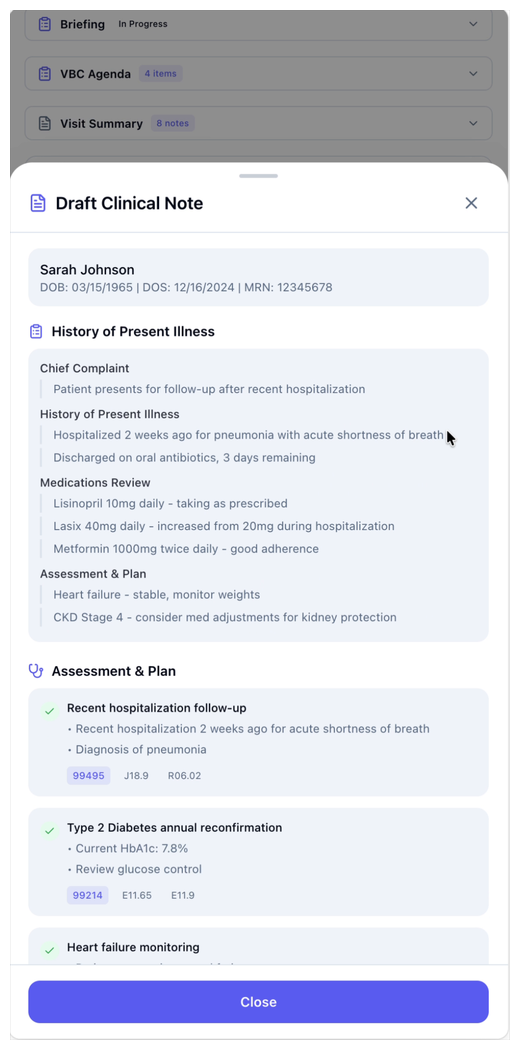
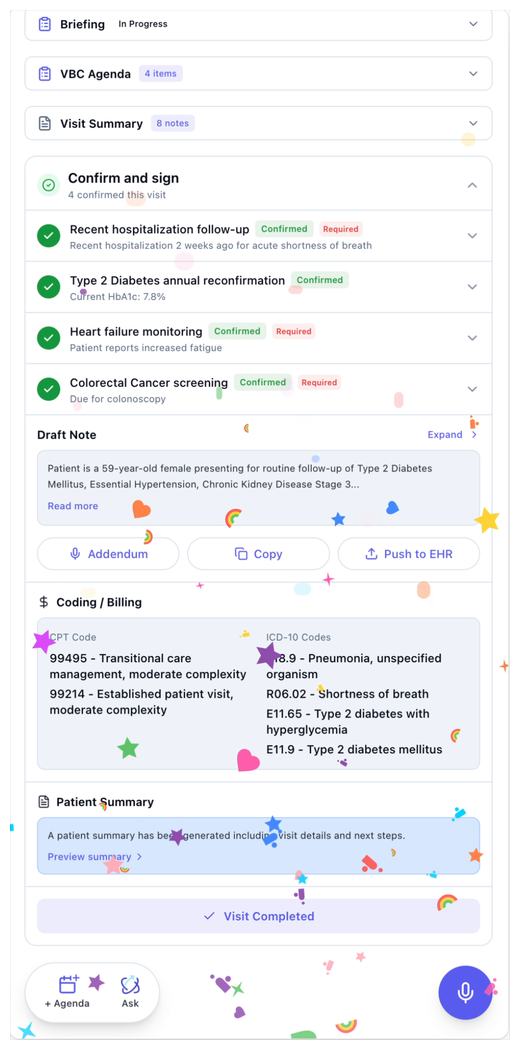
The flow ran in four stages — Schedule, Visit, Visit + Task, Visit completion — drawn at three breakpoints. Drawing the small breakpoint first, and completely, is what made mobile-first a constraint the teams designed against. Starting with the assumption that the provider would start with the agenda, and move into ambient scribing to focus on the patient, and have the visit note ready by the end of the visit. Each stage carried a user story, a hypothesis stated so it could be tested, open questions written into the artifact, and an explicit Included / Not Included boundary — so the scoping conversation happened inside the design, at the moment the tradeoff became legible.
Then the vision became an operating plan. Working with product leadership I broke it into workstreams sized by unknown, sequenced them across two quarters, and helped form pods around workflows. I held the experience architecture while a new design system was built underneath it and each team pushed its piece forward against real engineering constraints.
- 34% → 44%
- Deep engagement over the quarter, against a 55% target
- −0.4 → +0.5
- Best-in-class UX index
- 85%
- Clinical satisfaction score
- 14 → 1
- Parallel prototypes converged into one alpha flow
A VISION THAT DOES NOT LAND ON A ROADMAP IS JUST A MOOD
FROM MOOD TO ROADMAP
SIZED BY UNKNOWN
Each workstream was assessed on how much we did not know and how much impact it carried. The task system carried the highest uncertainty of anything on the list, so it was explicitly deferred to prevent blocking execution. The clinical agenda, high on both axes, got prototyping capacity early and a deliberately small validation target: one deeply engaged physician using it for real visits by end of quarter.
TEAMS AROUND WORKFLOWS
Workflow-owned teams argue about the seams, which is where the experience actually lives. A weekly working group kept the pods composable; a monthly cross-pillar session with the CPO and clinical lead kept the whole thing pointed at the vision.
DISPOSABLE CODE AS A DESIGN STRATEGY
Work ran in a feature-flagged module sandbox with its own data layer, on the explicit agreement that the code was throwaway. That removed the fear that makes exploration cautious, and let eight workstreams run in parallel without paralysis about committing to the wrong thing.
Convergence is a different skill from exploration
By midsummer the pods had produced roughly fourteen prototypes of the live visit experience. This was an intentional part of the strategy which allowed the team diverge and explore solutions with their own unique knowlege set. I spent the back half of the summer unifying the design system across surfaces, making the layout genuinely responsive, reconciling interaction patterns where two teams had solved the same problem differently, and preserving what was good in each rather than picking a winner.
HOW WOULD IT WORK END-TO-END?
A lo-fi interactive model settled the structural questions: what opens the canvas, where Sign lives, and what the drawer is allowed to cover. Scroll through its states.
FINAL UI EMBEDDED SHOWN EMBEDDED IN AN EHR
The result
The MVP went engineering-complete in June: a redesigned visit page built on the clinical agenda, assessments restructured, the scribe integrated into the visit, and a two-step completion flow with no regression on submission. The converged flow followed to a curated alpha cohort of six physicians across two health plans.
The central bet — that a clinical agenda beats an administrative checklist received early positive signal. It was the highest-risk item on the roadmap from the beginning and was correctly identified as such; the alpha existed precisely to test it. The organizational transformation was real and delivered.
In this vision the Briefing was a tool to frame the patient agenda. As the engineering and data teams built toward this vision, the reality of what our technology was capable of became clear, which is where The Shape-Adaptive Brief opens.
Back to work